
Condition-Based Monitoring of Switchgear
An IoT-enabled miniature switchgear prototype that watches temperature, humidity, vibration and acoustic signatures 24/7 to predict and prevent panel fires.
Abstract
Switchgear panels are critical components in electrical distribution systems, yet they are prone to catastrophic fires due to overheating, insulation degradation, partial discharges, and condensation from high humidity. Traditional preventive maintenance is periodic and often ineffective at detecting incipient faults, resulting in unplanned downtime and safety risks. This project presents a low-cost, IoT-enabled condition-based monitoring prototype designed to predict and prevent fires in low-voltage switchgear cubicles.
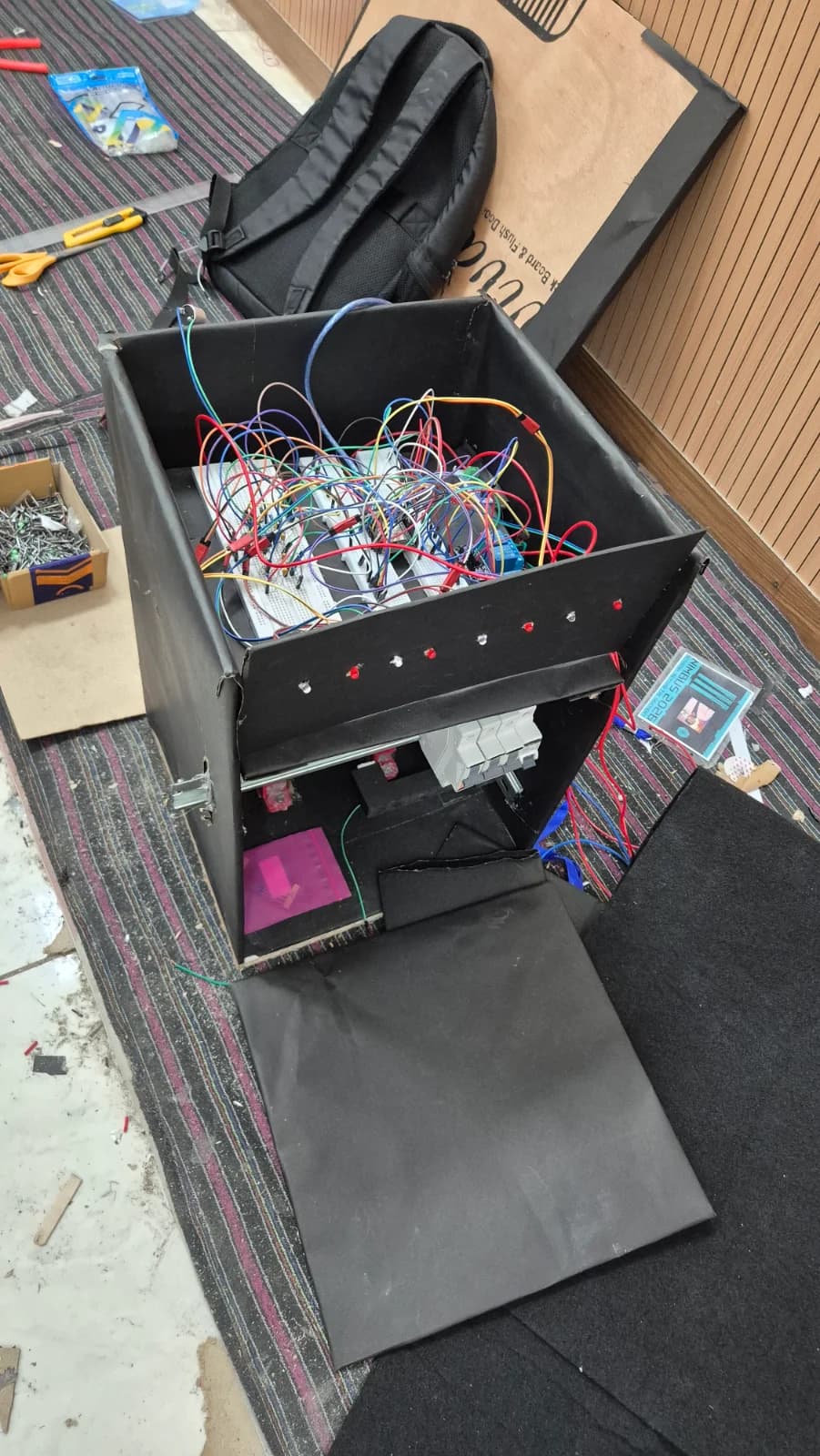
The prototype is constructed as a compact miniature low-voltage switchgear model within a safe enclosure, featuring copper busbars, a DIN-rail-mounted main breaker and feeder MCBs, and high-power resistors to simulate hotspots. An ESP32 microcontroller continuously acquires data from strategically placed sensors — DS18B20 probes at busbars and breaker terminals for temperature, a DHT22 for enclosure humidity, an HC-SR04 ultrasonic sensor for partial-discharge acoustic simulation, and an MPU6050 for vibration. Threshold logic drives escalating alerts: yellow LEDs and a soft buzzer for warnings, and red LEDs, a loud siren, and an automatic relay trip (with fan-based suppression simulation) for critical conditions. All data and alarm states stream over Wi-Fi to an IoT dashboard for remote monitoring, trend viewing, and instant push notifications.
Unlike reactive fire-suppression systems that act only after ignition, arc-resistant designs limited to premium new installations, or labour-intensive time-based inspections, this approach delivers autonomous 24/7 proactive monitoring of key fire precursors, retrofits without downtime, and shifts maintenance to condition-triggered action. The MQTT-based architecture extends naturally to multi-cubicle substation monitoring and adapts to transformers, motors, or cables with minor sensor changes.